
As I wrote over the weekend, Roanak Desai, a student I worked with for the past few months and felt quite close to, passed away on Saturday after contracting cerebral malaria. It's been a difficult couple of days, not only because Roanak was such a special person, but also because this loss comes so soon after the loss of my father-in-law in February. I've been coping, at various times, by appreciating life, by searching for meaning, and, today, by thinking in metaphors.
The metaphor I've found most comforting is of Roanak on a journey, one that obviously began long before I met him, and one that, in some sense, continues. He's on a boat, a choice inspired both by the literal image of his Facebook photo and by the symbolic idea that at sea you don't follow a predetermined route but must make your own way, an apt description of Roanak's path in life.
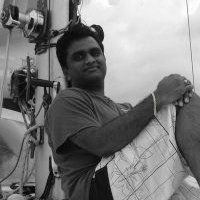
Roanak was such a humble and gracious person that when I first joined him on this journey, I didn't even realize that it was his boat--I thought we were both fellow passengers on a craft thoughtfully provided by the Stanford Graduate School of Business, the institution that brought us together. And at times, because of the nature of our work together in a coaching relationship, I even thought it was my boat, and I was guiding Roanak to his next destination. Of course, that's a trap that any coach can fall into in a relationship where the client or coachee is exploring important issues and finding meaning in the experience.
But while I'm often temporarily blinded by ego, it hasn't yet become a permanent condition, and in hindsight I can easily see the truth: it was Roanak's boat all along, and he had invited me to join him for this particular leg of his journey (which is actually a metaphor for any coaching relationship.) I expected my time with Roanak to last much longer, and I was shocked to find myself back on shore while he continued along without me. It didn't seem fair, and I felt abandoned.
I'm not a person of faith, so I don't have a sense of Roanak as I knew him continuing into an afterlife. But Roanak had a strong spiritual side and felt a connection with his culture's religious traditions, which makes it easier to extend the metaphor beyond this existence, in a way. I still see Roanak on his boat, receding into the distance. I have no idea where he's going--it's not possible for me to know--but I understand that our paths must diverge now.
And as I look around me, I realize that I haven't been abandoned at all--I'm actually surrounded by people who were also on board for various portions of Roanak's journey, including some who didn't even know it. There are dozens of people I recognize from Stanford, many of whom I know well and care for deeply, but with whom I now feel an even closer connection, because we realize that we've been traveling together. There are others I'm meeting for the first time, such as:
- A high school teacher of Roanak's who emailed me after finding my previous post and is now establishing a fund in his memory with her colleagues.
- A reader of my site who emailed to say, "I'm truly sorry for your and Roanak's
significant other's loss. This was a man who clearly touched your
soul. Your prose below does create a gain in information/knowledge for
me, and I'm sure others who you touch. So, for that, I am also
thankful for Roanak and his inspiration." - And a co-founder of Posterous who was struck by the Viktor Frankl passage I quoted and wrote, "RIP Mr. Desai. I never met you but it is clear you've left a hole in many people's lives and they miss you much."
Roanak found us all, at some point, and, whether we realized it or not, invited us to join him for a while.
Looking further, I see that in addition to all the new and deeper connections that have been established as a result of my time with Roanak, I've learned a great deal along the way. Far from abandoning me, Roanak carried me further along my own path, and left me in a better place than when I met him. I'm a better coach; I'm open to a wider range of experiences; I see more possibilities in others and in myself. Perhaps the greatest lesson I've learned is that while Roanak was an easy person to coach and to love and to learn from, as a result of our relationship I now feel more capable of coaching and loving and learning from everyone.
While I've found it incredibly helpful to reflect on my relationship with Roanak and write about him here, I know I'll be returning to other topics again soon--regular writing is as much a part of my coping process as my daily workouts. But I'll bear in mind an email I received yesterday from a student I worked with a few years ago and whose father had passed away:
I read somewhere that you mourn right after someone dies, but you will always be grieving.
There was something about that distinction that was comforting for me.
When I'm having a happy memory of my dad or feeling sad because I miss
him, I'm reminded that I'm still allowed to grieve for as long as I
would like.
That's deeply comforting to me as well. This experience of mourning for Roanak will end--it must, in order to my life to continue. And yet by allowing myself to continue to grieve, I can hold on to my happy memories of Roanak, and to the sadness of losing him, without being consumed by mourning. So again, good-bye, Roanak. It was a privilege to know you, to be your coach, to accompany you on your journey for a little while. I miss you. Thank you.

6 Responses
Ed, thank you. I'm a former GSB employee and current graduate student here at Stanford. I knew Roanak briefly through academic interactions but always sensed something incredible about him. I appreciated finding your website and am grateful for the support it has brought me during this time. With gratitude for your words. For me, 'tis a true delight imagining Roanak's soul continuing on his journey of impact and meaning. thank you. thank you.
Thank you, eln. I found it very helpful to think of Roanak this way, and it's nice to know that I have company.
Thank you, ah--I appreciate the kind words and am struck by the verse. Roanak left many ripples in his wake (like this one.)
ah ed how lovely. i knew him only slightly but feel in many ways the ripples of his impact on my life. your post reminds me of a passage from east coker (four quartets) i have been captivated by for some weeks:
Do not let me hear
Of the wisdom of old men, but rather of their folly,
Their fear of fear and frenzy, their fear of possession,
Of belonging to another, or to others, or to God.
The only wisdom we can hope to acquire
Is the wisdom of humility: humility is endless.
--
to me, your thoughts powerfully embody that wisdom of humility. thank you.
Thank you so much, Mary--I'm grateful for your comment and moved by your memories of Roanak. I also remember his laugh, and his rich, warm voice. And I like your definition of faith--perhaps it's simply where we find it.
Dear Ed,
What a beautiful tribute to Roanak. He was my son’s roommate at Harvard, so I knew him for a while – but not long enough. He was truly, as you said, “a humble and gracious person”. I remember meeting him and experiencing that unique warmth and acceptance that was his nature; I believe all who had the pleasure of knowing him, loved him. He was a rare gift, and I will remember him and his beautiful laugh and loving spirit always. You said you are not a person of faith, but I believe that you are because of Roanak – you trusted him and you loved him – that’s faith! Thank you for this touching article. I will save it with my other mementos of Roanak.